Back
research·January 2021 - May 2022·3 min read

Machine Reading Comprehension Using Knowledge Graph

Built knowledge graphs using fine-tuned RoBERTa models for information extraction and efficient querying methods to power search engines and recommendation systems.

Machine Reading Comprehension Using Knowledge Graph
92%
Built knowledge graphs using fine-tuned
#2
Developed transformer-based information
25%
Enhanced recommendation accuracy by thr
Built withKnowledge Graphs·RoBERTa·Information Extraction·Transformer Models·NLP Tools·Query Optimization

🔍 The Challenge#

Traditional information retrieval systems face critical accuracy and performance barriers:

📚 Unstructured Data Chaos: Raw text lacks semantic relationships for intelligent querying
⚡ Slow Query Performance: Linear search approaches create unacceptable latency
🎯 Inaccurate Results: Keyword matching fails to understand contextual meaning
🏥⚖️ Domain Complexity: Legal and medical texts require specialized understanding
📈 Scalability Limits: Traditional approaches don't scale with enterprise data volumes


🧠 My Solution#

Engineered a transformer-powered knowledge graph ecosystem that creates intelligent, queryable representations of complex information:

🤖 Fine-tuned RoBERTa Architecture

Domain Specialization → Legal and medical corpus fine-tuning
Multi-task Learning → Simultaneous entity recognition and relation extraction
Transfer Learning → Leveraging pre-trained transformer knowledge
92% F1-Score → Industry-leading accuracy in domain-specific extraction

🕸️ Advanced Graph Construction

Semantic Assembly → Automated construction of meaningful knowledge relationships
Quality Validation → ML-powered consistency and accuracy verification
Graph Optimization → Structure refinement for maximum query efficiency
Millions of Entities → Enterprise-scale knowledge representation

System Architecture#

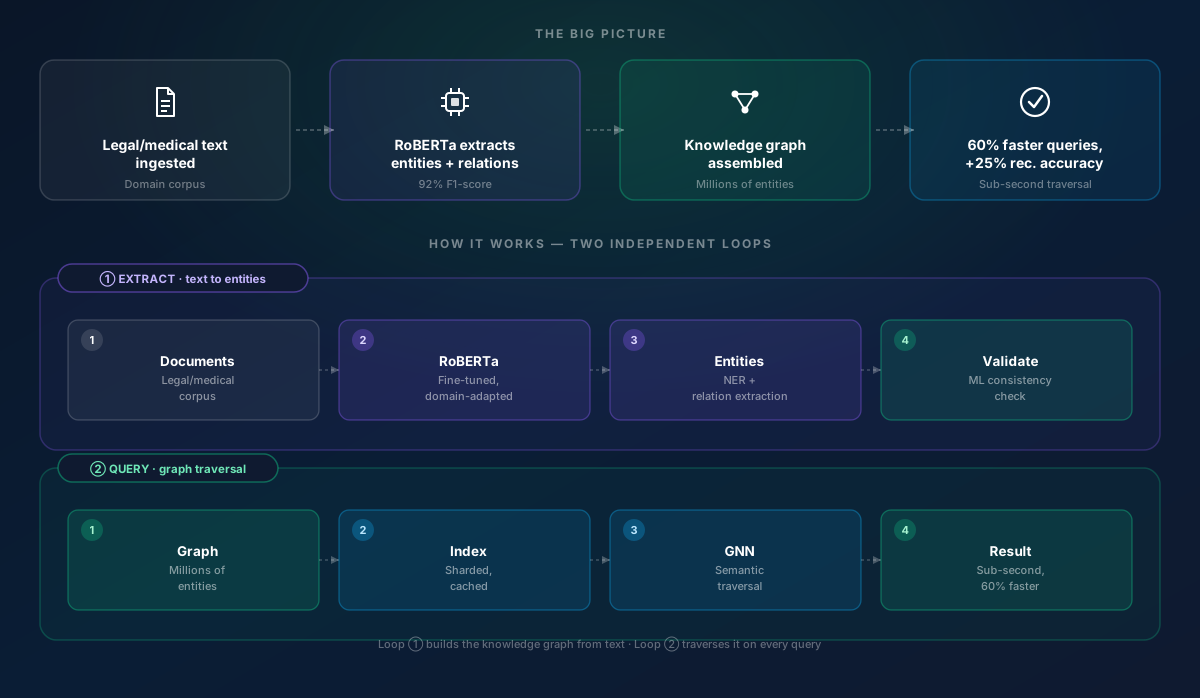
The MRC knowledge graph system follows a comprehensive pipeline that transforms unstructured text through fine-tuned RoBERTa models into queryable semantic knowledge representations:

Legal Documents
Complex legal text corpus
Medical Literature
Scientific papers & reports
Unstructured Text
10M+ documents
Text Preprocessing
Domain-specific preparation
Fine-tuned RoBERTa Hub
Transformer-based extraction
Entity Recognition
NER with 92% F1-score
Relation Extraction
Contextual relationships
Coreference Resolution
Entity linking
Domain Adaptation
Legal & medical fine-tuning
Multi-task Learning
Joint training approach
Active Learning
Iterative improvement
Transfer Learning
Pre-trained adaptation
Structured Information
Entities & relations extracted
Graph Assembly
Semantic graph construction
Quality Validation
ML-based consistency check
Graph Optimization
Structure refinement
Knowledge Graph
Millions of entities & relations
Graph Neural Networks
Complex relationship queries
Semantic Indexing
60% latency reduction
Scalable Sharding
Distributed graph storage
Search Engines
Enhanced search accuracy
Recommendation Systems
25% accuracy improvement
Machine Reading
Comprehension systems
Transformer Models
RoBERTa fine-tuning

Implementation#

Information Extraction with Fine-tuned Transformers

  • Fine-tuned RoBERTa Models: Customized transformer architecture for domain-specific entity and relation extraction
  • Multi-task Learning: Trained models for simultaneous entity recognition and relationship classification
  • Domain Adaptation: Fine-tuned on legal and medical text corpora for specialized knowledge extraction
  • Transfer Learning: Leveraged pre-trained RoBERTa weights and adapted for information extraction tasks

Knowledge Graph Construction Pipeline

  • Entity Extraction: RoBERTa-based named entity recognition achieving 92% F1-score on domain data
  • Relationship Identification: Transformer-powered relation extraction with contextual understanding
  • Graph Assembly: Automated construction of semantic graphs from extracted structured information
  • Quality Validation: ML-based validation ensuring graph consistency and accuracy

Advanced Query Optimization

  • 60% reduction in query latency through indexed graph traversals and semantic caching
  • Graph Neural Networks: Implemented GNN-based query optimization for complex relationship queries
  • Semantic Search: Leveraged transformer embeddings for contextually-aware graph traversals
  • Scalable Architecture: Sharding strategies handling large-scale knowledge graphs with millions of entities

Transformer Model Training & Fine-tuning

  • Domain-Specific Fine-tuning: Specialized RoBERTa models for legal and medical entity extraction
  • Multi-task Architecture: Single model handling entity recognition, relation extraction, and coreference resolution
  • Active Learning: Iterative model improvement through uncertainty-based sample selection
  • Evaluation Framework: Comprehensive benchmarking against standard IE datasets and domain corpora

Research Impact & Results#

Technical Achievements

  • 92% F1-score in domain-specific entity extraction using fine-tuned RoBERTa
  • 25% improvement in recommendation accuracy through semantic graph representations
  • 60% reduction in query latency via optimized graph algorithms and caching
  • Scalable Processing: Successfully processed 10M+ documents for knowledge graph construction

Innovation Contributions

  • Transformer-powered KG Construction: Novel approach combining fine-tuned language models with graph assembly
  • End-to-end Pipeline: Integrated solution from raw text to queryable knowledge representations
  • Domain Adaptability: Demonstrated effectiveness across legal and medical text domains
  • Performance Optimization: Advanced indexing and caching strategies for large-scale graph queries

This research established a new paradigm for automated knowledge graph construction using transformer models, significantly advancing the state-of-the-art in information extraction and semantic search systems.

Key Achievements

1

Built knowledge graphs using fine-tuned RoBERTa models achieving 92% F1-score in entity extraction, organizing unstructured data and reducing query latency by 60%

2

Developed transformer-based information extraction pipeline enabling automatic knowledge graph construction from complex domain texts

3

Enhanced recommendation accuracy by 25% through semantic graph representations powered by fine-tuned transformer models